
ECA INSIGHT >>
Energy access in displacement settings remains one of the most overlooked dimensions of global electrification efforts. Energy systems are often viewed as a ‘luxury good’ in refugee life, and thus energy technologies are marginalised in humanitarian practice.[1] As of 2026, 37 million forcibly displaced people lack access to electricity.[2] Approximately 94% of the displaced individuals residing in refugee camps lack access to electricity, and 81% rely on traditional fuels, such as firewood and charcoal for cooking,[3] contributing to environmental degradation and tensions with host communities.[4] At the same time, firewood collection is customarily treated as a gender-divided task, meaning that women and young girls are disproportionately affected, facing safety risks during collection and indoor air pollution from cooking. Thus, ensuring energy access in these contexts is not only a humanitarian necessity but a core component of a truly inclusive energy transition.
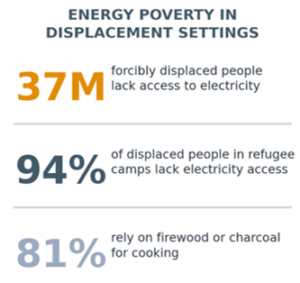
Figure 1 The energy access deficit of forcibly displaced people
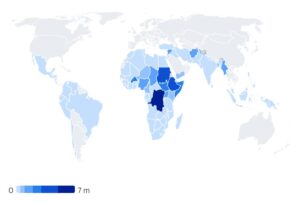
Source: Global Platform for Action on Sustainable Energy in Displacement Settings
Rethinking the “temporary” nature of displacement
One of the most persistent barriers to investment in displacement settings is the perception that refugee camps are temporary, making long-term infrastructure investments too risky. However, in practice, displacement is often protracted. Camps often exist for years or even decades, effectively functioning as semi-permanent settlements. For instance, the Zaatari refugee camp in Jordan was established in 2012 to host Syrians fleeing conflict. The camp was initially perceived as a short-term solution, yet more than a decade later, tens of thousands of refugees still reside there. The installation of a 12.9 MW solar plant in 2017 now provides reliable, clean electricity to approximately 55,000 people, enabling households to refrigerate food and medicine, children to study at night, and humanitarian agencies to reduce operational costs.[5]
Addressing perceptions of limited market potential
Another common concern is the perceived lack of a viable market in displacement settings, driven by assumptions about affordability. Yet this perception often stems from a lack of data rather than reality.
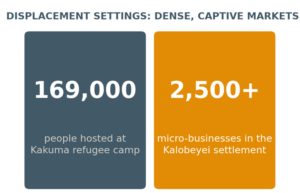
Evidence shows that refugee camps can represent dense, captive markets, often larger than typical rural communities targeted by mini-grid developers. For example, the Kakuma refugee camp, established in 1992, currently hosts over 169,000 people[6], while the Kalobeyei settlement in Kenya has a dynamic informal economy comprising more than 2,500 micro-businesses that provide a variety of goods and services.[7] Unlike dispersed rural communities, refugee camps represent clusters of households and businesses, which are typically sought after by mini-grid developers.
Despite the large market size of these settlements, the market potential is often constrained by limited affordability and access to finance. However, these challenges can be addressed by well-designed interventions. For instance, the Transforming Humanitarian Access program established Humenergi Uganda Ltd., a specialised financing facility which provides concessional working capital loans to off-grid energy companies aiming to work in refugee settlements in Uganda.[8] In addition, Inkomoko, as the largest lender to refugee entrepreneurs in Africa provides loans to displaced people with favourable lending requirements, as well as financial literacy, business and IT training.[9]
The key lesson is that no single financing mechanism is sufficient; a shift from the traditional focus of humanitarian NGOs on grants is required. Instead, tailored combinations of subsidies, concessional finance, technical assistance, and risk mitigation instruments are required to unlock private sector participation and create sustainable markets.
Bridging the data gap on energy demand
A further barrier to investment is the lack of reliable data on energy consumption patterns in displacement settings. Without robust data, developers and financiers face significant uncertainty, reinforcing perceptions of high risk.
Addressing this challenge requires comprehensive market assessments prior to any intervention, taking into account the previous living conditions and livelihood activities of displaced populations. Many refugees originate from urban or peri-urban areas and are therefore familiar with higher levels of electricity access and a broader range of electrical appliances than is often assumed. Failing to account for these characteristics can lead to demand being systematically underestimated.
A holistic energy access approach
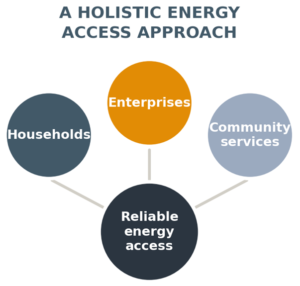
Achieving meaningful impact in displacement settings requires moving beyond a narrow focus on household electrification. A holistic energy access approach recognises that energy is needed across multiple dimensions: households, enterprises, and community services within displacement settings. For instance, Renewvia’s 2.5 MW mini-grid in the Kakuma camp powers thousands of SMEs (ranging from phone chargers and hair trimmers to carpentry and metalworking shops) and critical infrastructure like schools, telecom towers, boreholes, and the largest camp hospital.[10] Promoting productive uses of energy (PUE) within the refugee camps is crucial to enhance the ability to pay for energy services. A recent socio-economic impact assessment of a mini-grid installed at the Sheder Refugee Camp in Ethiopia found that almost all customers who use the mini-grid for income-generating activities have seen their income increase as a result.[11]
A holistic energy access approach also considers the role that UNHCR compounds and other humanitarian service facilities can play as anchor loads for renewable mini-grids, providing developers with a predictable demand base that improves project bankability while allowing electricity networks to be extended progressively to refugee households, businesses and community facilities. However, a key barrier is the financing mismatch between the long-term horizon needed by private mini-grid developers to recover their investments and the short-term budget cycles of humanitarian agencies (typically only one to two years).
Finally, a holistic energy access approach recognises that displacement settings are highly heterogeneous and there is no one-size-fits-all solution for their electrification. Smaller settlements may be best served by solar home systems, while larger and longer-established camps, particularly those with commercial activity and higher electricity demand, may justify investment in mini-grids. Integrating displacement settings into national electrification planning is therefore a prerequisite for developing energy solutions that are both technically appropriate and financially sustainable.
The challenges associated with energy access in displacement settings, including perceived impermanence, limited ability to pay, and lack of data, are not insurmountable. Ultimately, addressing energy poverty in displacement settings is not just a technical or financial challenge – it is a matter of equity.
[1] Rosenberg-Jansen. 2022. The Secret Life of Energy in Refugee Camps: Invisible Objects, Technologies, and Energy Systems in Humanitarianism.
[2] Global Platform for Action on Sustainable Energy in Displacement Settings. Quantifying the global sustainable energy access gap amongst forcibly displaced people
[3] Global Platform for Action on Sustainable Energy in Displacement Settings. The state of the humanitarian energy sector: challenges, progress and issues in 2022.
[4] UNHCR. Energy Solutions for Displacement Settings.
[5] UNHCR. 2026. Syrian refugee technicians help power Zaatari camp’s solar plant.
[6] About Kakuma – Project Kakuma
[7] Endev and Practical Action. 2021. Learning & Innovation: Humanitarian Energy for Micro-enterprises in Displacement Settings.
[8] Transforming Humanitarian Energy Access | Mercy Corps
[9] Refugee Energy Access – Ashden
[10] Igniting Opportunity: Shifting from Aid to Investment in Electrification for Displacement Settings | Global Platform for Action

Iro Sala
Consultant
Joining ECA in September 2021, Iro focuses on rural electrification in Africa’s off-grid sector, establishing best practices for sustainable public institution electrification and assessing public funding for off-grid solar. Holding an MPhil in Economics from Oxford and a BSc in PPE from King’s College London (where she researched gentrification in London), she specialized in urban-spatial, public, and behavioral economics, with her thesis analyzing regulatory competition and firm mobility in Europe.